Transmission and distribution operations and renewable energy construction look very different on paper. One supports the existing grid: line work, substation maintenance, upgrades, and inspections on energized infrastructure. The other is greenfield construction at scale: solar arrays across hundreds of acres, wind turbines erected in remote terrain, battery storage tied into new interconnections.
But operationally, they share the dynamic that quietly drives the most expensive safety failures in both sectors. Both run on distributed crews working across remote sites. Both rely heavily on contractors and subcontractors. And both operate on what OSHA calls multi-employer worksites, where responsibility for safety is shared, fragmented, and easy to lose track of.
That structure is where the real risk lives. Not in the obvious hazards every safety plan addresses, but in the gaps between employers, between sites, and between what was planned and what is actually happening on the ground today.

The Multi-Employer Problem
OSHA’s multi-employer citation policy is straightforward in concept but brutal in practice. At a single worksite, multiple employers can be cited for the same hazard. The general contractor can be cited as the controlling employer. The subcontractor whose crew was exposed can be cited as the exposing employer. The employer who created the hazard can be cited, regardless of which workers were near it. And the employer responsible for correcting the hazard can be cited for failing to do so.
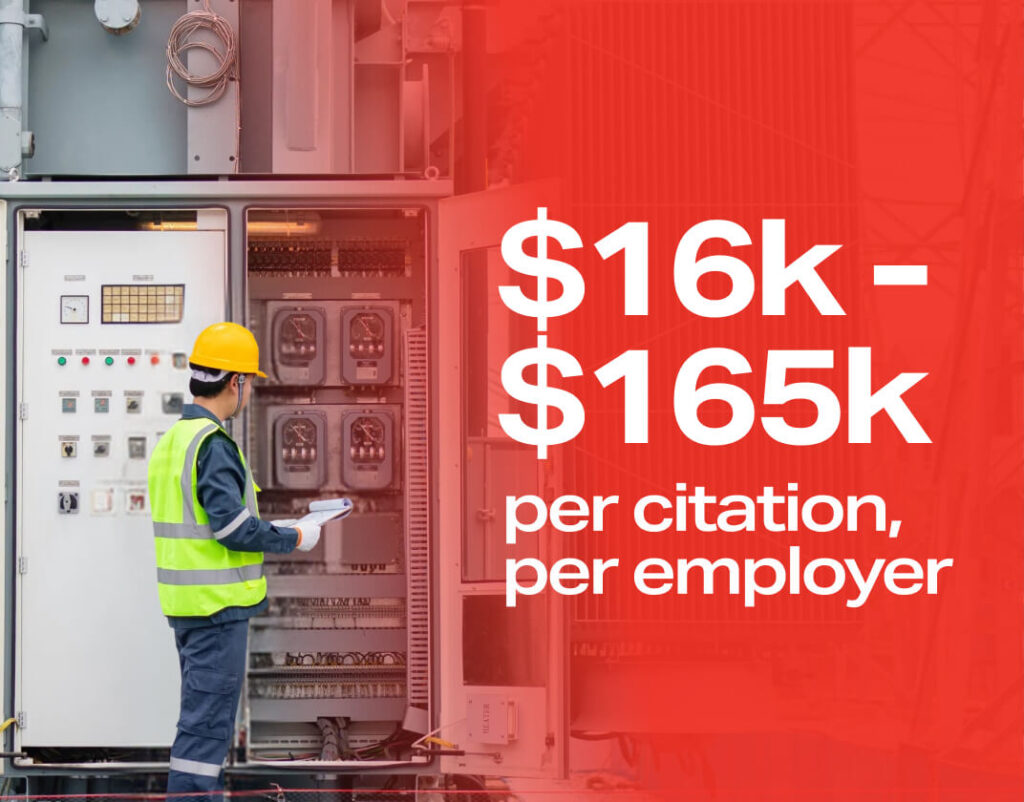
In 2026, the maximum penalty for a serious violation is $16,550 per citation. For willful or repeat violations, the maximum is $165,514. These amounts are per violation, not per inspection. A single inspection that results in ten serious citations across the prime and two subcontractors can exceed $150,000 in penalties before anyone has finished their morning coffee.1
For T&D operations, this plays out in substation upgrades, line replacements, and storm restoration work, where multiple contractors converge under tight schedules. For renewables, it appears in solar fields and wind farms, where civil, mechanical, electrical, and commissioning contractors work in overlapping phases within the same footprint.
The exposure is not theoretical. Utility construction and electrical contracting consistently rank among the industries with the highest fatal injury rates in the country. BLS data show fatal injury rates for electrical power-line installers and repairers ranging from 19 to 24 per 100,000 workers, multiple times the national average across all occupations of roughly 3.5. Three industry categories, electric power generation/transmission/distribution, power and communication line construction, and electrical contractors, together account for over 95% of those fatalities.2

$16,550
maximum penalty for serious violations from OSHA

19 to 24
fatal injury rates per 100,000 workers

$150,000
can be exceeded in penalties across citations

95% fatalities
from power generation and communication industries
Where the Gaps Actually Show Up
Most multi-employer safety failures are not exotic. They look like this:
- A subcontractor crew arrives at a solar site for civil work that was supposed to be completed a week ago. The mechanical contractor is already mobilizing on the same area. No one has updated the JHA to reflect the overlap.
- A T&D crew is dispatched to a substation expansion site where the prime contractor’s safety supervisor is at another site that day. The acting site lead is a foreman who has never conducted a multi-employer briefing.
- A worker on a wind project slips on a turbine pad. The injury is minor but recordable. The treating clinic is 35 minutes away. By the time the worker returns, three hours of crew time are lost, the incident log is incomplete, and nobody is sure who owns the OSHA 300 entry.
- A lockout/tagout sequence during a distribution upgrade involves the utility, the prime contractor, and two subs. Each has its own LOTO program. None of them is identical. The crew defaults to whoever is loudest.
None of these is a willful violation. None of them results in a fatality. But every one of them matches the exact pattern OSHA cites under the multi-employer doctrine, and every one of them is the pattern that turns a clean project into a recordable, a recordable into a citation, and a citation into an experience modification rate that follows the company for years
The Productivity Drain Nobody Tracks
Safety failures at distributed sites cost more than the citation itself. The bigger number is the productivity lost between the incident and the return to work.
Every time a worker at a remote T&D or renewables site is sent offsite for a drug test, a health screening, or treatment for a minor injury, the conventional approach costs 3.5 to 4 hours of productive time. Travel to the clinic. Wait time. Treatment. Return to the site. Re-briefing the crew. On a single project with 1,000 workers, recovering just one hour per worker per week through onsite occupational health translates to 52,000 hours annually, the equivalent of adding 25 full-time employees to the project without increasing headcount.3
On distributed operations with crews spread across multiple sites, the drain compounds. A T&D program covering ten active sites in a region multiplies the offsite-visit problem by ten. A utility-scale solar project with civil, mechanical, and electrical crews mobilizing in sequence over twelve to eighteen months loses productive hours each week to incidents that could have been resolved onsite in fifteen minutes.
This is the cost that does not show up on the citation. It shows up on the schedule.

What Embedded Safety and Occupational Health Actually Change
The fix is not more clipboard inspections or a thicker safety binder. It is a continuous, embedded presence in the field, integrated with the work and the workforce.
Embedded safety professionals coordinate across employers in real time. They lead the multi-employer briefings. They reconcile the LOTO programs before the crews arrive. They identify JHA gaps when sequencing shifts. They serve as the controlling employer’s eyes on the ground when the prime’s safety supervisor is at another site.
Onsite occupational health nurses treat the injuries that would otherwise require sending a worker offsite. They handle drug tests, screenings, and triage decisions. On power generation projects, this approach has resolved roughly 88 percent of medical events onsite without an offsite referral. The same model applies directly to T&D and renewables operations, where the distance to the nearest medical facility is often greater and the cost of offsite visits is correspondingly higher.
Documentation discipline is the multiplier. OSHA’s penalty calculation allows reductions of up to 60 percent for employer size, 25 percent for good faith, and additional reductions for compliance history and prompt correction. An employer with documented training, hazard assessments, and corrective actions can reduce a maximum-severity penalty by 80 percent. An employer with identical practices but poor documentation pays the full amount.4
The Renewables Gap and the T&D Reality
Renewable energy is scaling faster than the safety infrastructure supporting it. Solar developers, wind operators, and battery storage owners are bringing capacity online at a pace that frequently outruns the maturity of their safety programs, especially for the contractor and subcontractor crews who build the projects. The result is too many new operators learning multi-employer compliance the hard way, one citation at a time.
T&D faces the opposite problem. Operations are mature, hazards are well understood, and safety programs are extensive on paper. But the work is distributed across geographies in ways that make consistent execution difficult. A program that runs flawlessly at one substation can fall apart at the next site forty miles away if the supervisor differs and the contractor mix has changed.
Both sectors need the same thing: integrated safety execution that travels with the crews, not safety oversight that travels with the corporate org chart.
Sources
1 OSHA Penalty Schedule, January 2026 inflation adjustment.
2 U.S. Bureau of Labor Statistics, Census of Fatal Occupational Injuries. Monthly Labor Review, February 2018.
3 OnPoint Industrial Services, internal productivity analysis.
4 OSHA penalty calculation guidance, 2026.
About OnPoint
OnPoint provides a broad range of workforce, safety, and operational support services for transmission, distribution, and renewable energy projects. Whether clients need on-site safety professionals, occupational health nurses, customized safety programs, or consulting support, our experienced teams deliver solutions tailored to the unique demands of each project. From planned outages and substation work to renewable energy construction and grid modernization initiatives, we help clients protect their workforce, maintain compliance, and keep projects moving safely, efficiently, and on schedule.

