
Summer doesn’t ask for permission. By the time most industrial operations have their heat programs fully in place, workers are already logging shifts in 95-degree heat with a heat index that pushes well past 100. For the crews doing the real work inside vessels, on scaffolding, and running equipment across job sites that weren’t designed with shade in mind, hydration isn’t a wellness perk. It’s a survival variable. And yet, in our experience working across power generation, refining, and large-scale industrial turnarounds, water access is one of the most consistently underestimated pieces of a heat safety program.
Why Hydration Matters More Than Most Programs Acknowledge
Most safety programs mention water. OSHA requires it, at least one quart per worker per hour in heat conditions. But there’s a significant gap between having water on-site and having water that workers can actually get to, consistently, throughout a shift. That gap is where heat illness happens.
Research on occupational heat stress consistently shows that even mild dehydration, just 1 to 2 percent of body weight, measurably impairs cognitive function, reduces fine motor performance, and accelerates physical fatigue. On a job site where workers are making decisions about rigging, electrical systems, confined space entries, and heavy lifts, that impairment isn’t abstract. It shows up in slower reaction times, in judgment calls that are slightly off, and in close calls that get logged as near-misses rather than what they sometimes are: the leading edge of something worse.
The challenge is that workers often don’t feel significantly thirsty until they’re already meaningfully dehydrated. By the time someone is asking for water, they may have been running at diminished capacity for an hour or more. Hydration has to be proactive and accessible, not reactive and inconvenient.
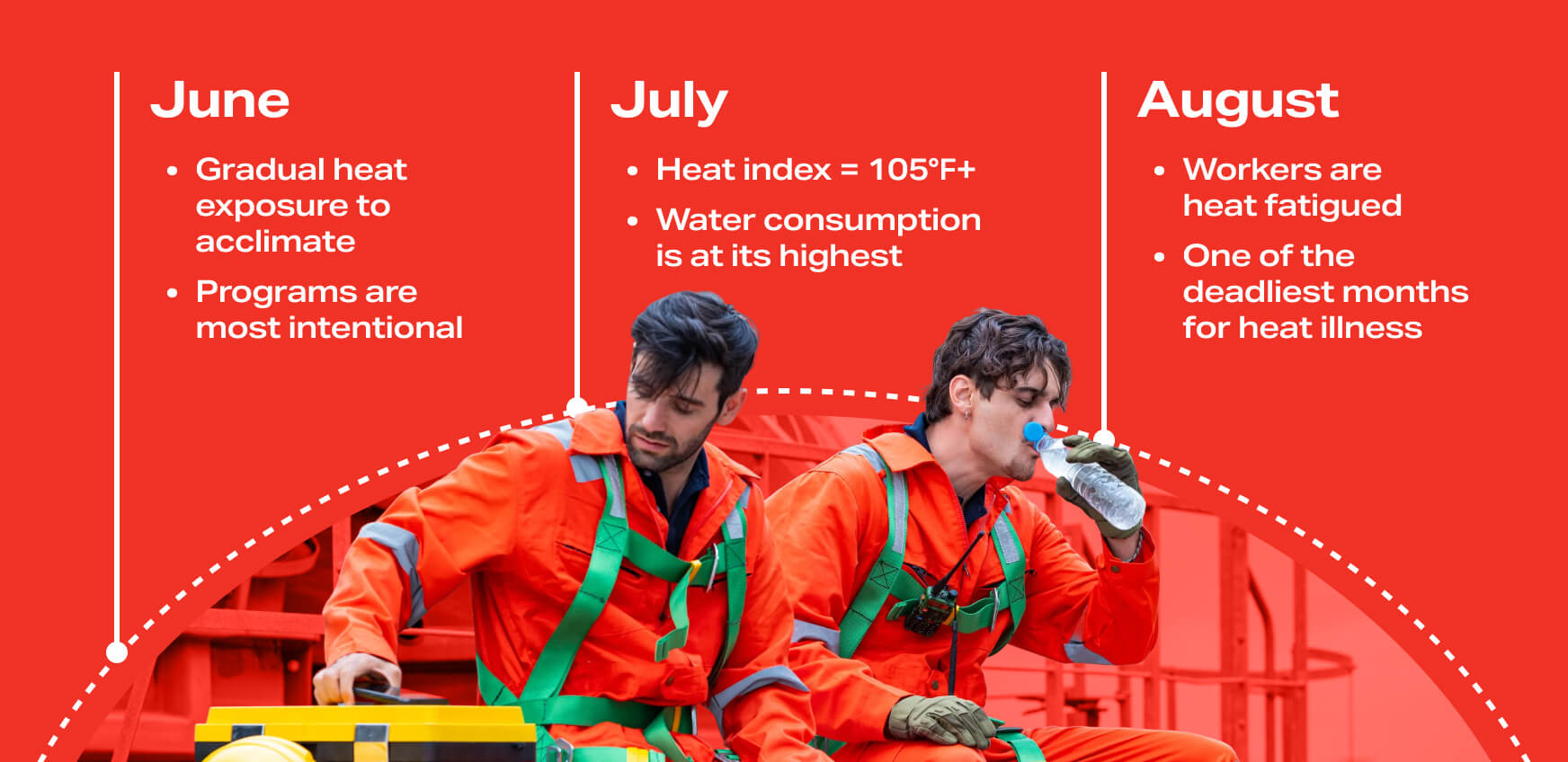
The Heat Season Arc: June – August
Understanding heat risk on industrial job sites means understanding how it builds over a season, not just on a given day.
Early Season (June):
This is when heat programs get stood up, when OSHA’s Heat National Emphasis Program is freshest in supervisors’ minds, and when workers are beginning to acclimatize. New and returning workers need gradual exposure. OSHA recommends that new workers spend no more than 20 percent of their first day working in the heat, building up to full exposure over seven to fourteen days. Programs built in June tend to be the most intentional.
Peak Season (July):
Heat index values across the Gulf Coast regularly exceed 105 degrees. Water consumption demands are at their highest. The logistics of keeping cold water accessible across a large job site with hundreds of workers becomes a real operational challenge. Patchworks of coolers, kegs, and ice chests scattered across a site create coverage gaps. Workers in confined spaces, at elevation, or at distance from staging areas are the most at risk of going without.
Late Season (August):
This is where programs fail quietly. Workers are fatigued from weeks of working in the heat. Crew rotations bring in new personnel who haven’t built up the acclimatization the rest of the team has. Supervisors who were vigilant in June start treating heat management as background noise. And yet the heat index in August across much of the industrial South is barely distinguishable from July.
Statistically, August is one of the deadliest months for occupational heat illness. Not because conditions are necessarily worse, but because the cumulative toll on workers and the erosion of program discipline create the conditions for incidents that earlier in the season would have been caught.
What Effective Water Access
Actually Looks Like
The standard for water access isn’t a cooler in the break room. It’s cold water within reach of where workers are. At the workface, inside the access corridor, staged at the entry point to the confined space, and available throughout the shift without requiring a trip across the site to find it.
On a large industrial turnaround with 200 workers running a 10-hour shift, OSHA’s one-quart-per-hour standard means 2,000 quarts of cold water every day. Managing that with a scattered collection of coolers and kegs requires someone filling them, distributing them, checking them mid-shift, and collecting and cleaning them at the end of the day. It’s a logistics operation that most project managers don’t calculate until it’s already consuming resources they didn’t plan for.
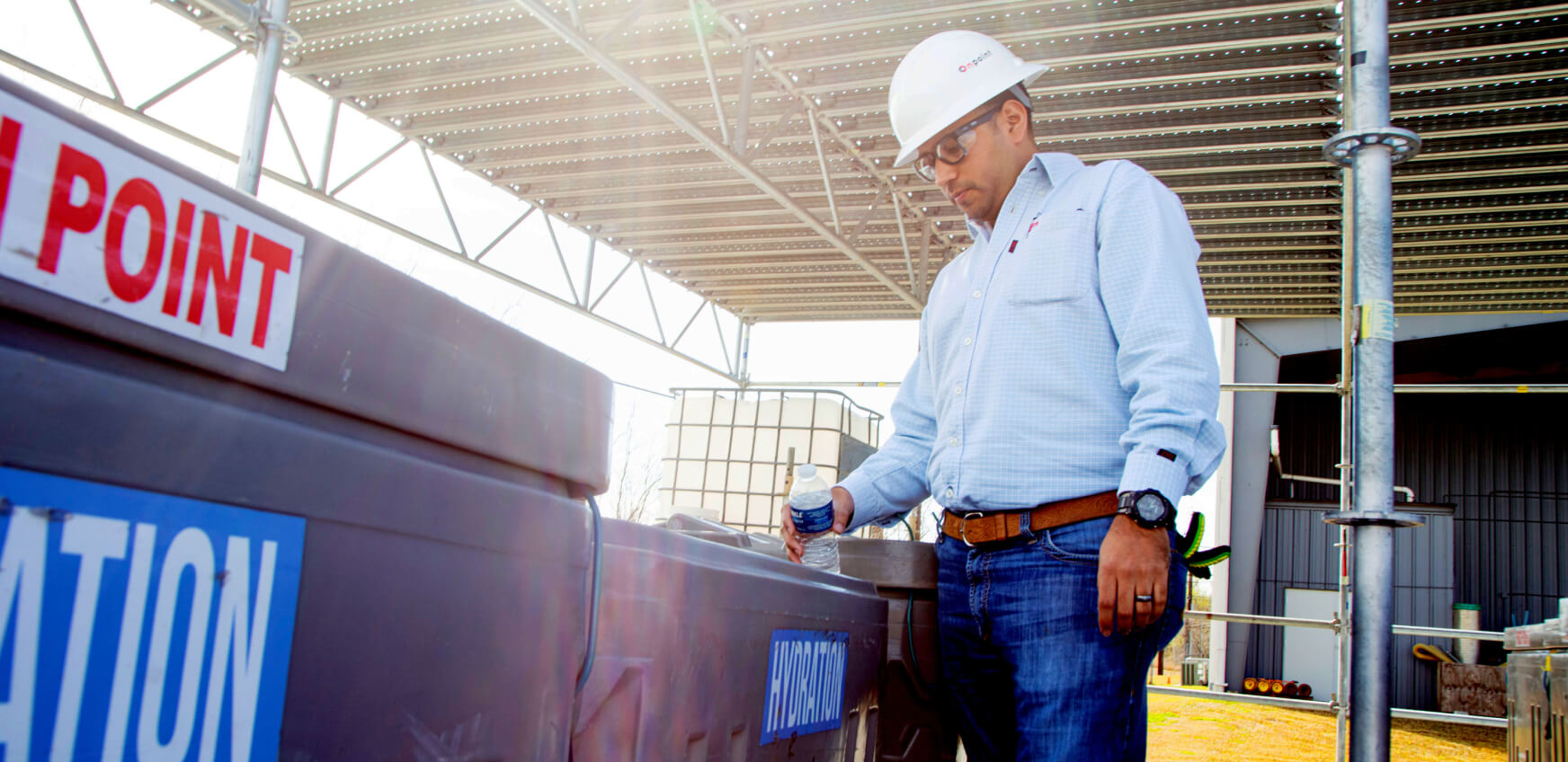
OnPoint’s Water Tote Service is Designed to Eliminate
That Overhead:
- Large, insulated totes holding 500 individual 16.9-ounce bottled waters
- Arrive pre-loaded with ice and stay cold for two to four days
- Picked up on a scheduled cadence when empty
- Flip-top lids reduce trash and clean up
- No kegs to fill, no coolers to manage, no staff time spent tracking down empties
The goal is simple: cold water where the crew is, consistently, without making it someone’s full-time job to keep it that way.
Hydration and Logistics are the Same Problem
One thing that often gets missed in heat safety planning is that water access and site logistics aren’t separate programs.
If cold water is staged at the perimeter of a job site and workers are at the workface, the water isn’t accessible in any practical sense. Workers who have to make a 10-minute round trip to get a bottle of water aren’t going to do it as often as they should. Not because they don’t care about staying hydrated, but because the job is moving and leaving the work for 10 minutes has a cost.
The same logic applies to how materials and personnel move across a site. Workers walking long routes to find materials or waiting for buses that aren’t running efficiently are accumulating heat load before they’ve done a minute of productive work. Integrated site logistics, with materials staged close to the workface, optimized transportation routing, and planned pedestrian flow, reduces the time workers spend in the sun unnecessarily. Heat management and logistics management are both about minimizing exposure. They work better when they’re planned together.
Safe+Sound Week:
A Prompt to Check What’s Actually Working
OSHA’s Safe+Sound Week, observed August 10-16, is built around a specific challenge: don’t just say your safety program works – find out if it does.
The three pillars OSHA focuses on every year have direct application to heat and hydration programs.

Leadership Commitment
Supervisors and site managers aren’t just aware that workers should drink water. They’re actively checking that cold water is available at the workface, that acclimatization plans are being followed for new and returning crew members, and that heat warning signs are being caught early rather than after someone is down.

Worker Participation
The workers who know where the water isn’t reaching, who know which corners of the site have no coverage and which shifts are running dry by hour six, need a real channel to say so without it becoming a problem for them. Near-miss reporting for heat events is almost never as complete as it should be, partly because workers don’t always recognize the early stages of heat illness as reportable events.

Hazard Identification
Walk the site specifically to evaluate water access. Don’t assume the coolers are full because they were full at the start of the shift. Check that workers in the highest-risk environments, including confined spaces, rooftops, and areas with high radiant heat, have accessible water and are actually using it.
Safe+Sound Week is a prompt. It’s an opportunity to do the audit that heat programs often skip, not whether water is available somewhere on the site, but whether it’s available where workers actually need it.
As Summer Winds Down:
What to Address Before Fall
August is also the right time to look ahead. Fall turnaround season is coming, and the gaps that this summer revealed in water access, logistics, and crew supervision during peak heat are the same gaps that will affect fall operations if they don’t get addressed.
A Few Questions Worth Asking Before the Season Turns:
- Did water access hold up under the actual demands of the job?
Not the plan, but what happened in practice. Were coolers running dry mid-shift? Were workers in confined spaces or at elevation consistently getting water throughout the day? - Did your acclimatization program account for mid-season crew turnover?
New workers cycling in during July and August need the same gradual introduction to heat conditions as workers who started in June. This step gets missed more often than it should. - Were heat warning signs caught early?
The difference between heat exhaustion and heat stroke is time and intervention. Programs that catch early signs, including heavy sweating, weakness, nausea, and a rapid weak pulse, before they escalate are programs with active supervision, not just posted signs.
The work of keeping crews safe in the heat doesn’t end when the temperature drops. The lessons from this summer’s heat season are the foundation for a better program next year and a safer fall turnaround season this year.
The Bottom Line
Hydration is the simplest part of a heat safety program. Water. Available. Cold. Where workers are.
But simple doesn’t mean automatic. On a large industrial job site, getting cold water to 200 workers across a 10-hour shift, consistently, from June through August, without creating a logistics drain on the project team, takes deliberate planning.
OnPoint’s Water Tote service and integrated site logistics are built around making that planning straightforward. If your current setup is working, keep it. If this summer exposed your gaps, now is the time to fix them.
Your crew deserves cold water at the workface. Make sure they’re getting it.
About OnPoint
OnPoint provides safety management, mobile drug testing, occupational health, logistics, confined space technology, and engineered ventilation services to industrial clients across power generation, refining, and large-scale project operations. Learn more at onpoint-us.com.

